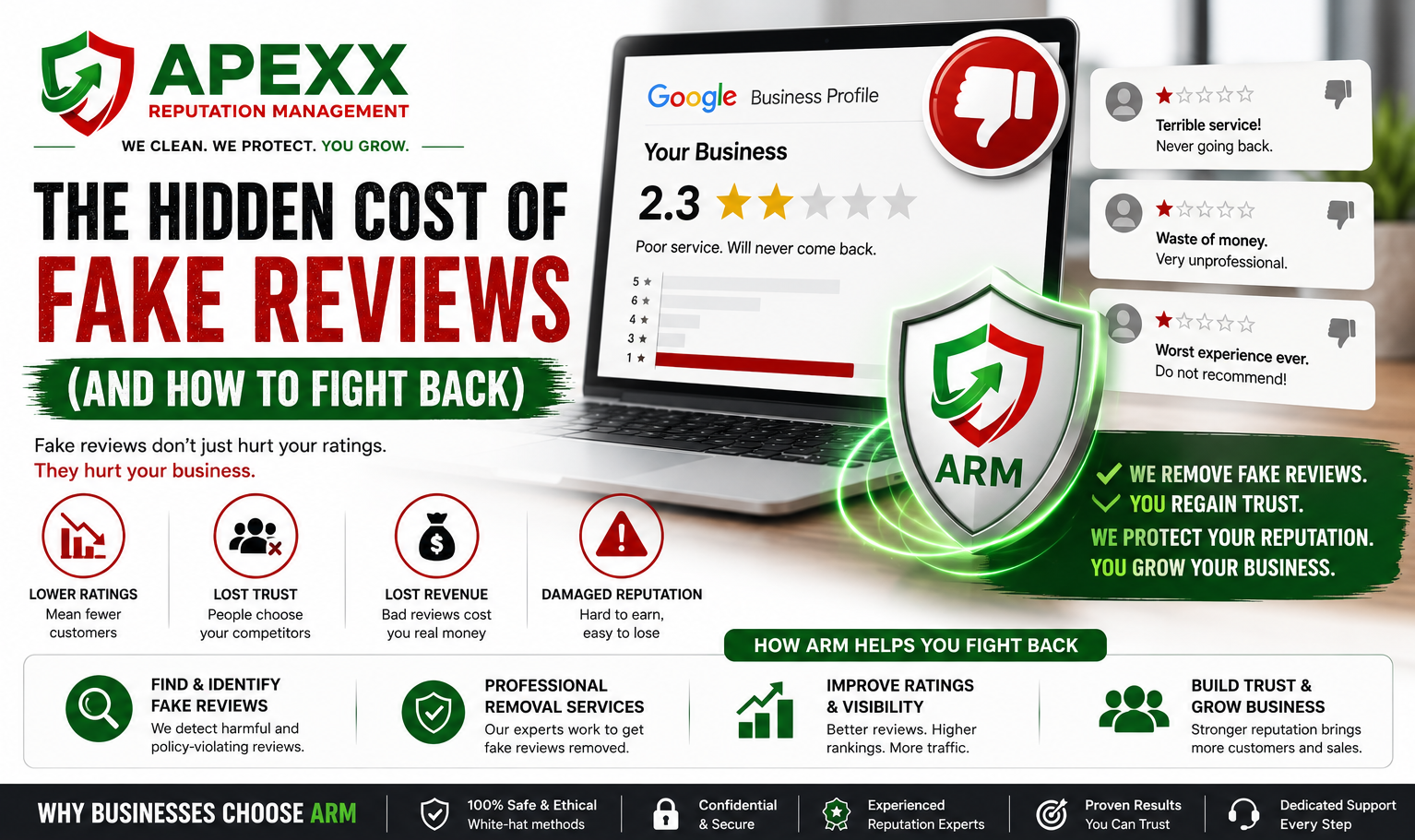
Imagine waking up, opening your laptop to check your business listings, and seeing your near-perfect 4.9-star rating suddenly plummet. A string of blistering 1-star reviews has hit your profile overnight. The comments accuse your team of malpractice, sketchy billing, and terrible service—but you have no record of these customers ever walking through your door.
According to Harvard Business Review data, a single-star drop on Yelp or Google can slash a business’s revenue by up to 9%. When those reviews are entirely fabricated by a malicious competitor, a disgruntled ex-employee, or a rogue internet troll, that financial hit feels less like a business hurdle and more like a targeted attack.
Unfair negative feedback doesn't have to be a permanent stain on your digital storefront. Here is how you can spot the anatomy of a fake review, understand why emotional responses backfire, and leverage professional strategies to permanently remove them.
1. The Anatomy of a Fake Review: How to Spot the Signs
Before you can fight a fake review, you need to prove it's fraudulent. Review platforms like Google, Trustpilot, and Yelp won't remove a comment just because it's negative—but they will remove it if it violates their Terms of Service (TOS).
Look for these dead giveaways that a review is fake:
-
The Vague Accusation: Real customers love specifics. They name the product they bought, the date they visited, or the employee who helped them. Fake reviews often rely on generic phrases like "Terrible place, awful staff, never go here!"
-
The Account History Check: Click on the reviewer’s profile. Do they have a pattern of leaving 1-star reviews for businesses in your exact industry across the country? Or is it a brand-new account with no profile picture and zero prior history?
-
The Sudden Influx: If your business usually gets three reviews a month and suddenly receives ten 1-star reviews in 48 hours, you are likely the target of a coordinated review bombing campaign.
-
The "Competitor Clue": If the review explicitly points customers toward another specific local business (e.g., "Don't go here, go to X Shop down the street instead"), you are likely looking at a competitor-rigged attack.
2. The Danger of the "Clapback": Why Arguing Publicly Backfires
When your hard work is publicly smeared, your immediate human instinct is defense. You want to reply, call out the liar, and clear your name.
Don't do it.
Getting into an emotional, public back-and-forth with a fraudulent reviewer almost always backfires for three distinct reasons:
1. It Feeds the Troll: If the review was left by a disgruntled ex-employee or an internet troll, a heated response gives them exactly what they want: validation. It often provokes them into posting more fake reviews under different accounts.
2. It Signals Authenticity to Algorithms: Engaging with a review signals to platform algorithms that the thread is active and relevant, sometimes pinning the negative review to the top of your profile for longer.
3. It Alienates Future Customers: Prospective customers reading your reviews don’t know the backstory. If they see a business owner responding with anger, sarcasm, or defensiveness, they won't care who was right—they will just see a business that is difficult to deal with.
If you must reply while waiting for removal, keep it brief, entirely neutral, and strictly professional: "We take all feedback seriously, but we have no record of any customer under this name or matching this description. Please contact our manager directly at [Email] so we can investigate your experience."
3. How Professional Removal Services Clean Up Your Profile
Many business owners try to flag a fake review once, get an automated "We found this does not violate our policy" response from Google or Yelp, and give up. They assume they are stuck with the damage.
That is where professional Online Reputation Management (ORM) firms like Apexx Reputation Management come in. Removing defamatory content isn't about using "hacks" or secret relationships; it is a methodical, legal process built on deep platform policy expertise.
Navigating Platform Terms of Service (TOS)
Every major platform has strict guidelines regarding what is allowed. Professional removal services don't just ask platforms to take a review down because it's mean; they build an evidence-backed case proving the review violates specific clauses, such as:
-
Conflict of Interest: Proving the reviewer is a direct competitor or former employee.
-
Harassment/Hate Speech: Identifying abusive language or targeted smear campaigns.
-
Spam & Inauthenticity: Demonstrating the review is from a bot, a click-farm, or a duplicated account.
Why Context Matters
While an automated system might miss the nuance of a fake review, a structured appeal written by ORM experts targets human moderation and legal compliance teams. By treating review removal as a compliance issue, professional services can successfully and permanently scrub defamatory content from Google, Trustpilot, Facebook, and Yelp.
Protect Your Bottom Line
Your online rating is your digital handshake. Don't let fraudulent, malicious reviews dictate how much your business earns or how your community perceives your brand. Spot the fakes, stay calm, and bring in the experts to clean up your digital footprint legally and permanently.
Is your business currently dealing with a sudden wave of unfair or fake 1-star reviews? Don't let your revenue suffer. Contact Apexx Reputation Management today for a free consultation, and let us handle the removal process for you.